
News

Nic Gill is a Tasmanian author and conservation dog handler who writes about nature and animals for all ages. Her work has appeared in The Guardian and The Best Australian Science Writing. Before transitioning into conservation dog handling, Nic worked as a botanist and in invasive species management. But a chance meeting with Dr Romane ‘Rom’ Cristescu and Maya completely altered the course of her career.
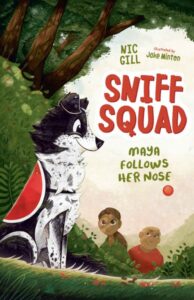
She has created a brilliantly fun series that tracks the transformation of Maya, a timid border collie who is abandoned at a local shelter, only to be rescued for a vital new career in koala conservation.
Win a copy of Maya Follows Her Nose
We have two copies of Maya Follows Her Nose from the SNIFF SQUAD series to give away!
Want to get your hands on one? Be one of the first two people to enter by emailing digital@landcareaustralia.com.au with the subject line ‘Sniff Squad’.
Good luck — and happy reading!
What inspired you to write Sniff Squad?
I met Maya and Rom when I was researching my first book, Animal Eco-Warriors, and was blown away by how they worked together, using Maya’s clever nose to help save koalas and their habitat. Not only did they inspire me to get a conservation dog of my own, but I was so impressed by their work with local wildlife that I decided I had to share their story with a broader audience. It took me many years and drafts to find the shape of the story, and so when my UWA Publishing agreed to a series featuring not just one but multiple Australian conservation dog teams that I greatly admire, it really was a dream come true.
What makes native animals so special?
The sheer size and geographical range of our continent and millennia of care by First Nations peoples have blessed Australia with an assemblage of ecosystems found nowhere else on earth. I see native animals as the visible spirits of our living landscapes – creaturely ambassadors for the environments they call home – whose very existence inspires empathy and action in people who come to know them.
This is why I find invasive animals and plants so upsetting. Native ecosystems are like intricate paintings, rich and colours and textures, but the wash of invasive species into a landscape is like slopping over an original artwork with boring beige paint. Native animals can act as a reminder of the beauty and biodiversity that we are bound to both savour and protect.
What do you love about Junior Landcare and what’s your favourite activity in the Learning Centre?
I love that Junior Landcare provides opportunities for kids to get their hands dirty and to have some fun while learning about and protecting the landscapes that nurture us all. This may be considered a slightly unusual choice, but I’m actually huge fan of the Learning Centre activities that target weeds. I did my Honours thesis on environmental weeds, and have worked, often in a hands-on capacity with Landcarers and Bushcarers, on managing invasive plants for a large chunk of my career. Having professionally exterminated more invasive plants than I’d care to remember, anything that reminds people of weedy impacts on our native ecosystems gets a big thumbs up from me!
Why do you think it’s important Australian children learn to care about the environment from an early age?
“Give me the child at seven and I will show you the adult”
I’m paraphrasing an ancient philosopher here, but I do believe that what we learn as kids shapes our behaviours across the span of our lives. I’m unashamedly keen to shove my science-forward, tree-hugging, animal-loving ideas down the throats of anyone keen to ingest them, but I especially love crafting stories for children, especially those kids not lucky enough to have the access to farms and native bush that I did as a child. Books can be portals to worlds of wonder, and I only hope that some of mine may magically transport kids to wild worlds they’d never otherwise encounter.
Why is storytelling such a powerful way to capture children’s attention and get them excited about science, geography, and sustainability?
Humans are sometimes called “the storytelling animal” – we’ve used stories for millennia to share information, expound on ethics and test out ideas.
More recently, studies have shown that reading well-written fiction can also create a greater sense of empathy in the reader — an effect not seen when reading traditional non-fiction texts. Though Maya Follows Her Nose is based on real events, I used some techniques from fiction to represent the interests of the more-than-human world from the inside of a dog’s head. While we can never know what an animal really thinks or feels, I’m hoping that readers might be caught up in Maya’s hopes and fears, and as they are swept along, they’ll feel just a little more empathy for the non-human world – dog and nature alike.
 Teachers & Educators
 Parents & Carers
 Youth or Community Groups
 Biodiversity
 Food Production
 First Nations Perspectives
 Waste Management
0 Comments